100 Listeners and Three Episodes. That's All Spotify Now Asks Before You Can Charge Your Audience.
Spotify switched on paid Memberships in 34 markets with a 90% creator split and an entry bar low enough to be almost theoretical.
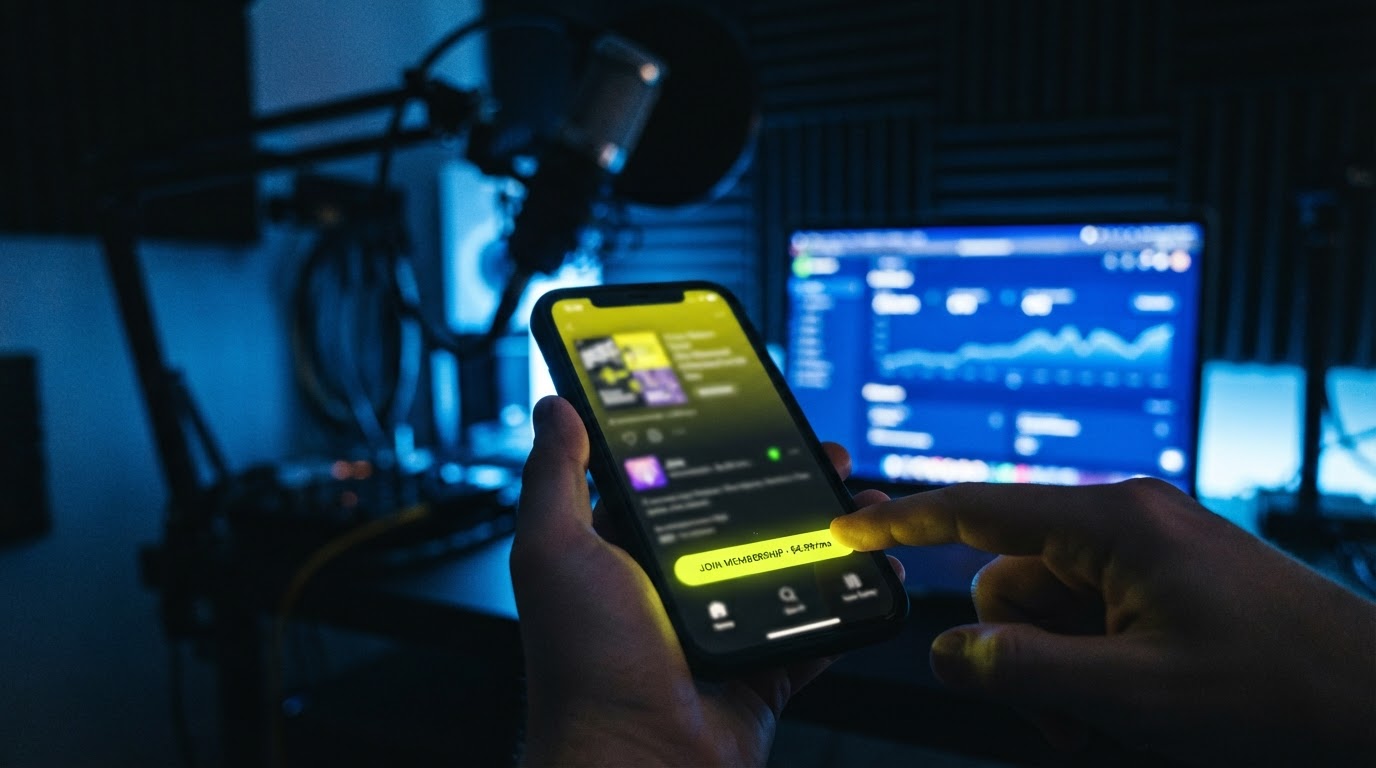
Three published episodes. One hundred listeners. One hundred hours of listening in the last 30 days.
That is the entire qualification. To set up a membership on Spotify you need at least 3 published episodes, at least 100 consumption hours on Spotify in the last 30 days, and at least 100 listeners or viewers on Spotify in the last 30 days.
Meet those three numbers and you can start charging money on a platform that reported 788 million monthly active users and 306 million Premium subscribers as of September 30, 2026.
Spotify launched paid memberships on Tuesday, October 20, a new way for podcasters to make money from their biggest fans beyond paywalled bonus episodes. Eligible creators can sell exclusive audio or video, bonus episodes, early access, archive access and fewer ads across multiple tiers, and keep 90% of the revenue they generate.
If you sell knowledge for a living, stop thinking about podcasting for a second and look at the structure. A platform with three quarters of a billion users just made recurring paid membership a default feature, priced its own cut at 10%, and set the door at a hundred people.
The 90% is real, and here's how they're paying for it
The detail buried in the launch coverage is where the money actually moves. Spotify told TechCrunch that memberships will be purchased on the web, not through in-app purchases.
That keeps Apple's and Google's app-store commissions out of the transaction, and it's a big part of what makes the 90% split possible.
For comparison, in the same market: Spotify's 10% cut matches Patreon's standard platform fee for new creators, although Patreon charges payment processing on top, while Apple Podcasts Subscriptions takes 30% in a subscriber's first year and 15% after that, plus an annual program fee.
One thing nobody has confirmed. Creators keep 90% of revenue, but Spotify has not said what comes off first, such as payment processing fees. Until that's answered, treat 90% as a headline number rather than a deposit.
The bar next door is ten times higher
The eligibility threshold is the part that should make every course creator sit up.
In January 2026, Spotify lowered its Partner Program bar to 1,000 engaged audience members and 2,000 consumption hours over 30 days, with three published episodes. That program pays creators out of Premium engagement and advertising.
Memberships asks for a fraction of that. The Memberships audience requirement is one tenth of the Partner Program's and the hours requirement is one twentieth, by PPC Land's calculation. Only the episode count is the same.
A show with a few hundred regular listeners has no route into Partner Program payouts, but can now sell a monthly tier to its most committed fans. Spotify is not hiding the intent. The company says Memberships are "designed to make monetization accessible to creators at different stages of growth."
Translation for this audience: the ad-revenue game still requires scale. The membership game now requires an audience smaller than most people's email list.
What the launch creators are actually charging
The initial lineup includes The Adam Friedland Show, Making Sense with Sam Harris, Shawn Ryan Show, The Sculpt Society, and Two Hot Takes, alongside YMH Studios rolling out the feature across 12 shows in its network.
The most instructive case is Morgan Absher. Absher has nearly 1 million followers on Spotify, where they listen to her comedy podcast Two Hot Takes. Three years ago, when she was looking to launch a membership program for her most devoted fans, she had to set it up through a separate platform, Patreon. Now Spotify is launching a feature that will allow her to offer paid subscriptions on its app.
Absher told Natalie Jarvey's Like & Subscribe that the memberships she offers through Patreon have already become "a big part" of her revenue from podcasting, and she's introducing a monthly bonus episode exclusively for fans who sign up for a $4.99 per month membership through Spotify.
Her reasoning is not a funnel strategy. "People just want more content, so that's what I'm offering," she says, adding that she's seen memberships help to grow the community around her show.
One bonus episode a month. Five dollars. That's the offer from a creator with a million followers, and it's a useful reality check for anyone building a membership with eleven content pillars and a weekly live call.
On pricing, creators can split benefits into up to three tiers, each with its own price, and while Spotify isn't setting prices itself, its own mockups use $4.99 per month with a seven-day free trial as an example.
The part that should worry you
Qualifying is not selling. Meeting the thresholds does not guarantee paying subscribers, and creators still need benefits their audience considers worth purchasing.
There's also the question of who owns the member. At Spotify's Investor Day in New York on May 21, 2026, the company said podcast Memberships would launch later in summer 2026, starting with select creators, and that creators would be able to import and export subscriber lists across platforms. Whether that export actually works at launch is the single most important thing for anyone whose business depends on owning a customer list.
And the obvious strategic trap: independents and networks now have to decide whether a membership tier inside Spotify is worth splitting their paying audience across Apple, YouTube, Patreon, and everywhere else they already sell access.
Set against the course world, the comparison isn't clean. As of October 2026, Kajabi Basic is $143 a month billed yearly and Teachable Starter is $39 a month, with Teachable's Starter plan carrying a 7.5% transaction fee while Kajabi takes no revenue share. A flat monthly fee beats a 10% cut once the revenue gets big enough. It loses badly at $200 a month.
Which is exactly the segment Spotify just opened the door to.
Sources
- Spotify launches paid podcast memberships with perks beyond bonus content — TechCrunch
- Spotify lets podcasters keep 90% of fan Membership revenue in 34 markets — PPC Land
- Setting up a membership — Spotify for Creators
- Spotify's Newest Weapon in the Creator Wars: Paid Membership — Like & Subscribe (Natalie Jarvey)
- Spotify's Newest Weapon in the Creator Wars: Paid Membership — The Ankler
- Pay up, superfans: Spotify wants a cut of your podcast devotion — Mediaweek
- Spotify Opens Paid Memberships in 34 Markets, Fees Unclear — Podwires
- Spotify launches podcast Memberships, creators keep 90% of the revenue — GSMArena
- Spotify rolls out paid podcast memberships in 34 markets — World Today Journal
- Spotify Technology S.A. Form 6-K, Q3 2026 — U.S. Securities and Exchange Commission
- Spotify Memberships Launch in 34 Markets With Paid Perks — Nyongesa Sande
- Kajabi vs Teachable: Plans, Fees and Fit for Course Creators — Lilach Bullock
Editor’s note: A platform with 788 million users just made recurring membership a default feature at a 90% split and a 100-listener entry bar. That's a pricing event for everyone selling knowledge, not just podcasters.
Keep reading
Coursera Just Posted a $377 Million Quarter. Then It Told Wall Street Consumers Are Slowing Down.
The biggest quarter in Coursera's history came with a Q4 forecast lower than the quarter it just reported — and the reason should interest anyone selling courses.

Sequoia Passed on Whop Once. Last Week It Led a $205 Million Round at $5.1 Billion.
The platform where people sell courses, coaching and paid communities says it went from $60 million to $400 million in annualized revenue.

Zumba Is Mailing $229 Checks to 4,543 People Who Bought Its Online Course. The Order Confirmation Page Did It.
A $2.7 million settlement over tracking pixels on a course checkout page just put every knowledge business with a Meta pixel on notice.

Patreon Is Deleting a Billing Model in 13 Days. Don't Pick a Number and It Picks One for You.
Per-creation billing dies November 1. Creators who ignore it get migrated on a default multiplier, with member billing paused until they log in.