An Alphabet With No Letter F. The CEO Says They're Already Demoting Stores Like That.
TPT's parent company confirmed it runs algorithmic tools to bury stores full of AI slop — and nobody gets a warning before the traffic goes.
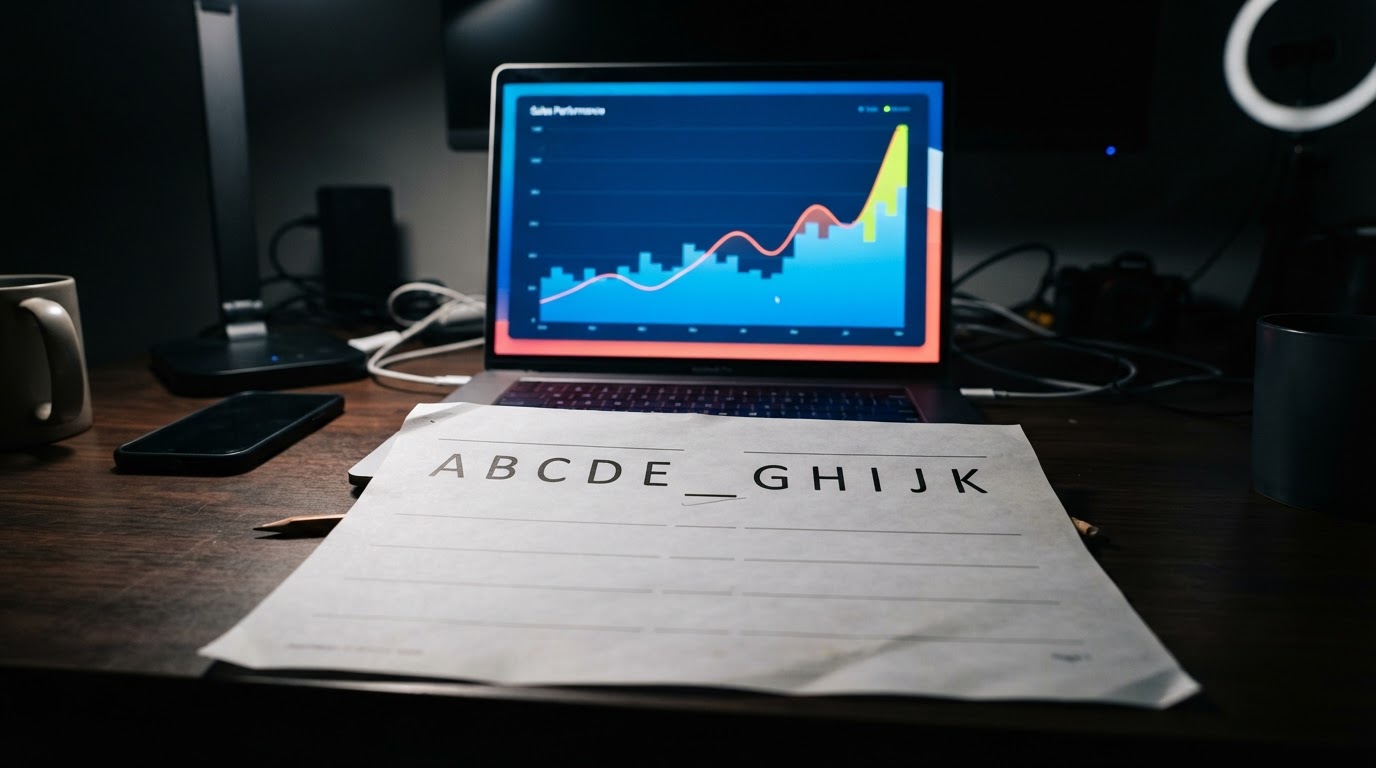
A reporter went shopping on Teachers Pay Teachers and came back with an alphabet worksheet missing a letter.
Chalkbeat went looking for classroom materials that appeared to have been generated by AI, and found a $1.99 alphabet coloring worksheet with no letter F, plus a $1.50 poster of U.S. presidents that used an asteroid hurtling toward anti-slavery demonstrators to illustrate Martin Van Buren's resilience. For $4, a teacher could get a Black inventors poster, slideshow and seven-minute video.
That's the funny part. Here's the part that should make every knowledge-product seller sit up.
The platform is already sorting you
In an emailed statement, Paul Mishkin, CEO of IXL Learning — TPT's parent company — wrote that the company uses "algorithmic tools to identify and demote stores associated with low-quality, AI-generated content."
"These measures are already highly effective, such that AI-generated products account for a minuscule fraction of a percent of TPT's sales," Mishkin wrote.
Read that twice. Not will demote. Not are building a system to demote. Already demoting, already effective, already reflected in the sales numbers.
The word doing the heavy lifting is stores. Not products. Not listings. The penalty described attaches to the shop, which means a seller's good work can get dragged down by the batch they rushed.
And nobody gets an email about it. Your dashboard doesn't say demoted. It just says fewer sales than last month.
Meanwhile, the coaches are selling volume
This is the collision worth watching. There's a cottage industry of creators who advertise themselves as coaches for people wanting to start a TPT shop, and in one YouTube video a creator said that leveraging AI isn't about replacing creativity, but "multiplying our efforts" to supply teacher resources online. Many of those coaches do tell creators to edit and check the output.
So one set of incentives says publish more, faster. The other quietly reranks you for it. Chalkbeat quoted Catharyn Shelton, a professor at Northern Arizona University, saying that turning teacher sharing into a marketplace can push creators to build shops with thousands of pages of material while sacrificing quality.
This isn't a worksheet problem
TPT is not a niche. Its parent company said in a 2023 press release that 85% of U.S. pre-K-12 educators use the platform, and the site, which rebranded as TPT in 2022, is education's answer to Etsy. Real sellers have built real businesses there — in 2022 the company announced that more than 300 teachers had earned at least $1 million in profit from the marketplace.
The detail that lands hardest is a small one. A Chalkbeat reporter asked ChatGPT to respond to inquiries about low-quality AI teacher resources as if it were the creator of those resources, and the AI wrote, "I do use AI-assisted tools as one part of my creative process."
That sentence is now the default defense in every knowledge marketplace on the internet. The platforms have started grading it.
Sources
- An alphabet without an F: AI slop seeps into Teachers Pay Teachers curriculum marketplace — Chalkbeat
- An alphabet without an F: AI slop seeps into Teachers Pay Teachers curriculum marketplace — ParentsTogether
- Learning never slops — Chalkbeat Newsletters
- Five Policy Fights Just Became Teacher Work — 3andB
- Teachers Pay Teachers — Wikipedia
Editor’s note: A platform CEO saying on the record that stores get algorithmically demoted for AI content is the clearest warning shot yet for anyone scaling knowledge products with AI.
Keep reading
Somebody Sat Down and Read 90 Teachable Creator Reviews. 44 Gave One or Two Stars.
A new audit sorted 202 Trustpilot reviews by who wrote them. Among creators the complaint is almost always money — and it isn't only Teachable.
Skillshare Closed 14 of His Classes. The Announcement Promised to "Invest in Being More Human."
A teacher who earned nearly $16,000 on Skillshare watched most of his library go dark in three weeks. The category purge is still running.
They Sold Beginners "Essential" Training for Up to $3,600 a Year. The FTC Just Banned Charging Them at All in Year One.
The record $225 million Amway settlement is being read as an MLM story. Read the complaint and it's a course-business story.
Spotify Put Courses in Front of 600 Million People. Then It Deleted the Catalog and Refunded Everyone.
Spotify's own help page says the course catalog came down on March 31, 2026. Six months later, the creator world still hasn't read the terms.