His Piano Course Still Makes Five Figures a Month on Autopilot. His Course About Courses Doesn't.
Gillian Perkins and Jacques Hopkins both run the same evergreen webinar funnel in two different markets. Only one of them still sells while they sleep.
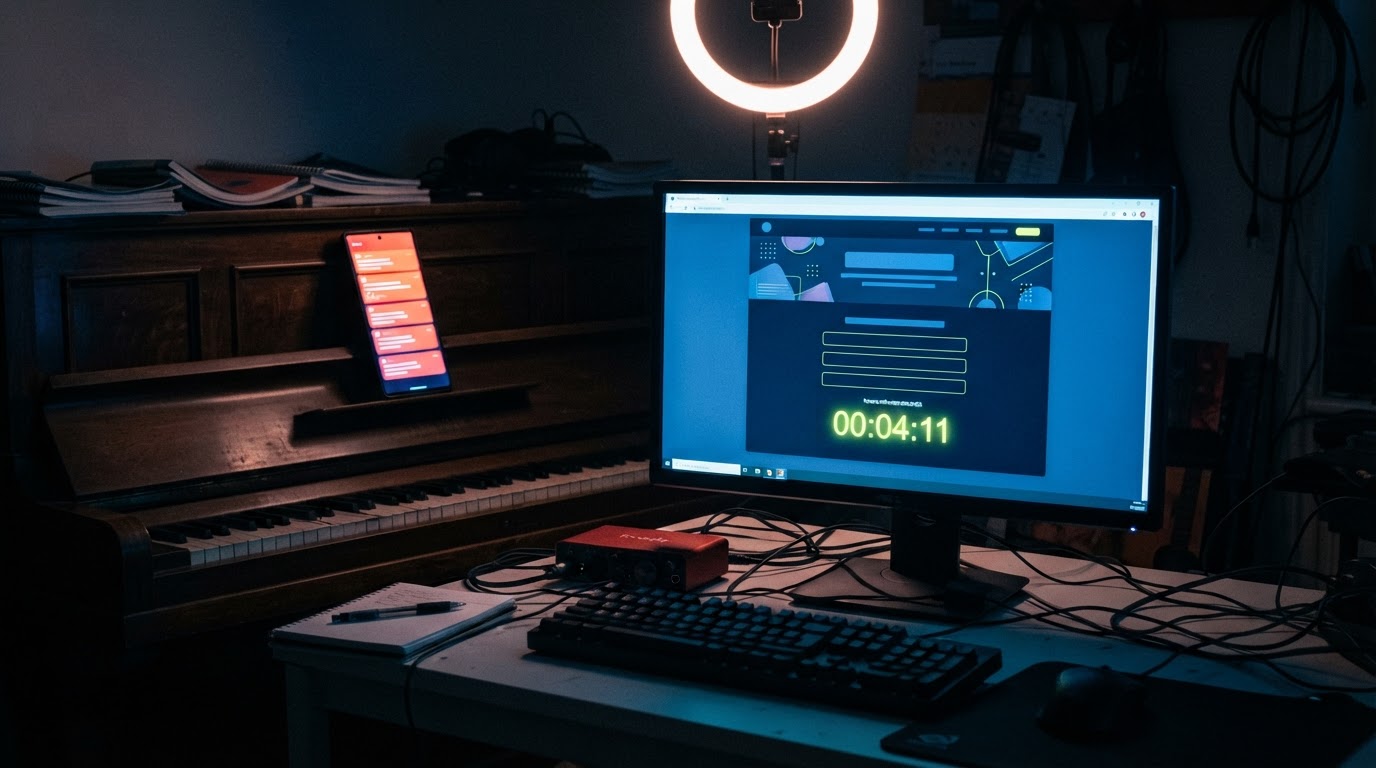
Same operator. Same funnel. Two completely different outcomes.
Gillian Perkins published a state-of-the-industry post in May that quietly contains the most useful diagnostic any course creator will read this year, and it is buried in a paragraph about a piano teacher.
Perkins wrote that she recently interviewed Jacques Hopkins, who started in 2013 with a course called Piano in 21 Days and now runs a brand called The Online Course Guy, and that he told her he experiences the exact same thing she does: his piano course consistently makes five figures a month from an evergreen webinar, but for his online course brand he has to get creative, using a "choose your own adventure" style webinar and live launches to break through.
One man. One skill set. One playbook. The piano audience still converts on autopilot. The course-creator audience does not.
The funnel isn't broken. The audience has seen it.
Perkins is in the same position from the other direction. With her YouTube strategy course, Creator Fast Track, she says they still get sales every week from an evergreen webinar she recorded a long time ago. The YouTube-strategy buyer still responds. The make-money-online buyer has been through this sequence a hundred times.
Her explanation is the part worth pinning above your desk. She attributes it to buyer sophistication, saturation, and desensitization to the most common marketing strategies, including the classic evergreen webinar funnel she has used and loved for years. Her read: that funnel still works really well in basically every other industry.
That is a very different claim from "evergreen is dead." It says the mechanism is fine and the audience is exhausted.
What the piano funnel is actually doing
The Piano in 21 Days numbers are not small, and they are not new. Perkins described it on her own blog as an $800 online piano course that has earned over $4 million in revenue. Hopkins has said the course, launched in 2013, let him quit his engineering job and has consistently generated five figures in monthly revenue.
The turning point was the funnel itself. On Smart Passive Income, Hopkins said revenue for Piano in 21 Days hit $22,000 in January 2017 and hasn't come in below $20,000 since, and that the biggest turning point was implementing an evergreen funnel.
The mechanics are unglamorous. He has described it as an on-demand webinar rather than a fake-live one, a video on a page people opt into with an email address, followed by a discount that expires after a set window. ActiveCampaign runs the sequences; Deadline Funnel enforces the deadline.
Nothing in that stack is unavailable to his course-creator audience. That's the point. They've bought that stack. They've built that stack. They recognise the deadline timer on sight.
The diagnostic
Strip it down and you get a question worth asking about your own market before you blame your copy:
How many times has your ideal buyer already been sold to using this exact structure?
If the answer is "almost never," a recorded webinar and an expiring discount can still carry a business for a decade. If the answer is "weekly, by people they follow," the funnel isn't underperforming. It's being read as a genre.
The tell isn't a falling conversion rate on the sales page. It's registrants who never show, replays that go unwatched, and deadline emails that stop moving anyone. The offer gets skipped before it's ever heard.
Perkins' broader argument is that the ceiling is specific, not general. She notes there are more players in the space than ever, that a lot of people started in 2020, and that standing out is harder even for people who have been at it a long time. Her conclusion: most industries are actually just as easy, if not easier, to sell courses in than ever before.
Which means the operators struggling hardest right now are disproportionately the ones teaching other people how to sell courses. They built the saturation they're standing in.
The piano students never got the memo. They just wanted to play something by Friday.
Sources
- Are Online Courses Still Selling in 2026? An Honest Look at the State of the Industry — Gillian Perkins
- $4M from a... PIANO course?? w/ Jacques Hopkins — Gillian Perkins
- SPI 430: Passive Income Success Story: How Jacques Hopkins Finally Made (Significant) Money Online — Smart Passive Income
- $4M Annually - Teaching how to play piano in 21 days - Jacques Hopkins of Piano in 21 Days — Trep Talks
- How Jacques Hopkins Sold $4M Worth of an Online Piano Course — Side Hustle Nation
- How I Make $30K/Month Working 1 Hour/Month [Update] — Starter Story
Editor’s note: Two named operators, publicly, saying the same funnel works in one market and stalls in another — that's a cleaner diagnostic than any 'is evergreen dead' think piece.
Keep reading
He Spent 31 Years in Miami Fire Rescue. His $925 Course Now Sells in 47 States Without a Single Ad.
Freddie Fernandez retired running 14 fire stations. His assessment-center prep business reaches firefighters in 47 states on referrals, challenge coins and phone calls.
He Left a $250K Software Job to Interpret Dreams. The Business Is Now Projected at $1.2 Million.
Michael Sheridan's dream interpretation school went from $125K to a projected $1.2M — and the growth lever wasn't new content.

She Stopped Writing Extra Paywalled Posts. Her Paid Subscribers Now Get Her Instead.
A book coach's small October decision lines up with a pattern across solo knowledge businesses: the paywall is being rebuilt around access, not content.
They Pay $249 a Month for the Community. The Community Is on Discord.
A reviewer found 388 paying members and just 219 posts on one Skool page. The room wasn't dead — it had moved somewhere you can't see.