Same Course, Same Price, 2.6x the Payout. It Depends Entirely on Who Sent the Buyer.
Udemy pays instructors 97% when the student arrives through their link and 37% when the marketplace sends one. That gap is the whole business.
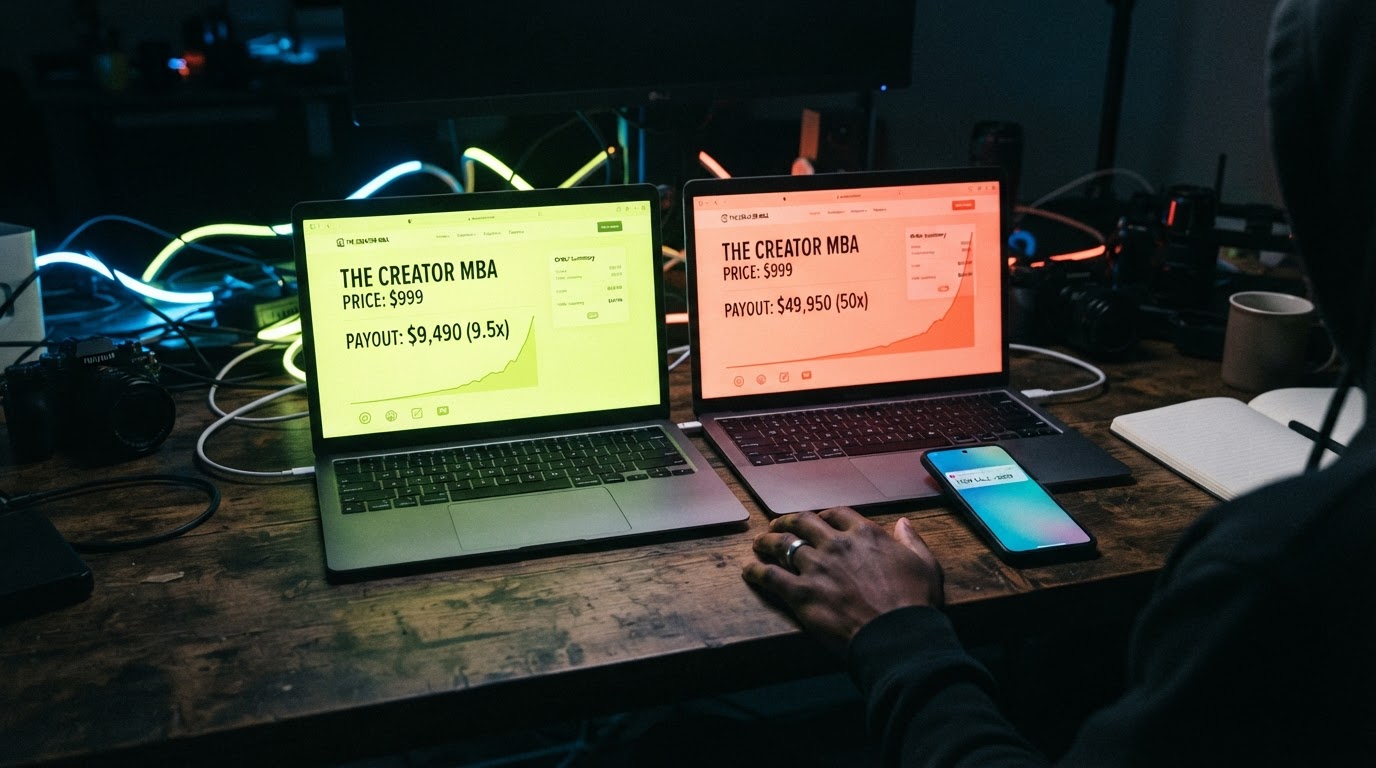
Two students buy the same course on the same day for the same price. One instructor gets paid nearly three times as much as the other. It's the same instructor.
The only variable is who sent the buyer.
Udemy pays instructors 37% of an organic marketplace sale, 97% of a sale through their own coupon or referral link, and 15% of Udemy Business subscription revenue — down from 25% in 2023, cut in three stages through January 2026. Affiliate-driven sales pay 25%.
97 divided by 37 is 2.62. One sale you brought is worth 2.6 sales the marketplace brought.
The line that decides your year
An independent analysis of hundreds of thousands of courses put the average Udemy instructor's earnings at $3,306 a year, with 75% making less than $1,000 and only 1% clearing $50,000.
Run that average through the split. An instructor doing $3,300 a year entirely on marketplace traffic is generating roughly $8,900 in gross sales and handing over $5,600 of it. Move the same gross volume to coupon links and the payout is about $8,650.
Same course. Same students. Same price. Roughly $5,300 a year in difference, for one group of people and not the other.
The marketplace isn't free traffic. It's the most expensive traffic you'll ever buy.
That 63% is a customer acquisition cost. It's just invisible, because it's deducted before the money reaches you rather than charged to a card.
Priced honestly, you are paying a 63% commission on every sale the platform originates, forever, on a course you already made. No paid channel on earth charges that and survives — because on every other channel you can see the number.
There's a second cost. Udemy runs frequent $9.99–$14.99 sales and instructors cannot opt out. You keep 37% of a price you didn't set.
When the listing still earns its keep
Three cases, and they're real ones.
Discovery you genuinely cannot buy. Udemy's search and recommendation engine can surface a course to students who have never heard of you. If you're unknown in a category with search demand, 37% of something beats 97% of nobody.
Social proof manufacturing. Enrollment counts and review volume compound. Average earnings for instructors who joined before 2020 are $5.4K versus $2.1K for those who joined since — a gap attributed to accumulated reviews and search ranking.
Volume at a price point you'd never run yourself. The $9.99 buyer is not your $499 buyer. Different customer, different shelf.
Where the link should point
Every link you control — email, bio, YouTube description, podcast notes, DMs, your own site — should be an instructor coupon link. Never the bare course URL. A student who found you first and clicked a plain listing link pays you 37%, and you earned that sale.
That one swap is worth more than most launch tactics, and it takes an afternoon.
The context matters too. Udemy completed an all-stock merger with Coursera in May 2026; instructor agreements and payouts were unchanged at close, though analysts expect continued downward pressure on payouts. The subscription share has already been cut three times in three years.
The 97% has one thing going for it that the 37% never will: it doesn't depend on anyone else's decision about how to split your revenue.
Sources
Editor’s note: One line in a revenue-share table quietly decides whether a marketplace is a sales channel or a hosting bill — and most instructors have never run the math.
Keep reading
A Student Paid Her $97 in 2017. She Was Still Working for That Sale in 2020.
Monica Froese retired four Pinterest courses partly because of two words on her own sales page. Here's the real cost of "lifetime access."
Six Readers Out of 1,000 Will Pay You. That's the Median — and It Doesn't Kill the Business.
beehiiv published the arithmetic most course creators only guess at: 0.62% conversion, $100 a year, and a subscriber who sticks around six to twenty months.
"Business Coaching" Is Now a Flagged Category. Your Payment Processor Just Got the Memo.
An FTC order against processor Nuvei defines coaching programs and auto-renewing subscriptions as higher-risk merchants — and spells out exactly how they get screened.

The Median Course Sells for $110. If You Teach Coaching, It's $531.
Ruzuku ran 72,162 paid price options through its database. The platform median is modest — and it shatters the moment you sort by niche.