OpenAI Just Shipped an Ad Where the Click Doesn't Land on Your Sales Page
A leaked ChatGPT format became an official product in 48 hours. The qualifying conversation now happens on OpenAI's surface, not yours.
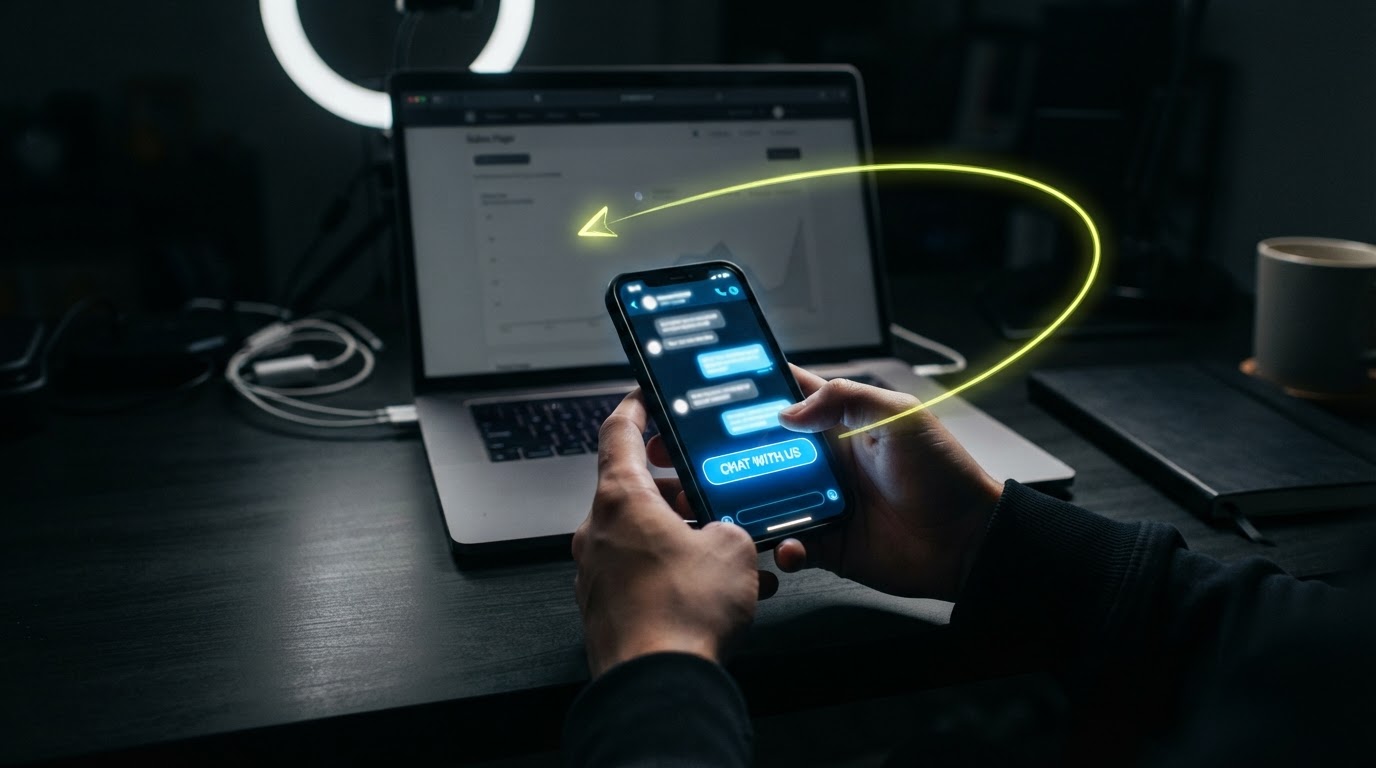
On September 14, Digiday reported that it had watched a video of something OpenAI was quietly showing a handful of advertisers. The format lets an advertiser attach a branded business agent to an ad, and the call-to-action button says something like "Chat with us." The click does not open a browser tab and does not land on the advertiser's site.
Two days later, OpenAI stopped treating it as a secret. On September 16 the company published a post introducing new AI-powered experiences for ChatGPT Ads, confirming it is testing Sponsored Agents, which let people start a conversation with a business-sponsored agent after clicking an ad in ChatGPT.
For anyone whose business is built on getting a stranger onto a sales page, that is a structural change, not a feature update.
What actually happens after the click
OpenAI's description is specific: after seeing a relevant ad, a user can choose to start a clearly labeled conversation with a business-sponsored agent in ChatGPT, explain what matters to them, ask follow-up questions, and follow a link to the business's website when they're ready to take the next step.
Read that last clause twice, because it is where the hype and the reality separate. The link to your site still exists. It just stops being the first thing that happens. It becomes the last thing that happens, after a conversation you didn't host, on a page you don't own, with a visitor you can't see.
OpenAI says the Sponsored Agent conversation is distinct from ChatGPT's independent answers and separate from the user's original ChatGPT conversation. It is being tested with select advertisers in the US.
The one confirmed tester is not a course creator. It's a furniture retailer. "Yes, Wayfair is participating in OpenAI's Sponsored Agent pilot to explore how conversational commerce can help customers make more informed, confident decisions," said Morgan Brown, the retailer's director of paid media, who added that Wayfair is testing at limited scale with guardrails around product accuracy, transparency and service handoffs. OpenAI's own illustration is a shopper who spots a dining table in an ad and wants to know whether it fits their space and how many people it seats.
Dining tables. Not $2,000 cohort programs. But the mechanic is identical to the one every knowledge seller already runs manually in DMs.
The comparison that should make you sit up
One agency executive who saw the format reached immediately for a precedent. "This is similar to Meta Ads that send people to WhatsApp," said Farhad Divecha, group CEO of Accuracast. He framed it as a way to open lines of communication with prospects, after which advertisers can qualify the ones who need to talk further.
That is the whole game for high-ticket knowledge products. Click-to-WhatsApp and click-to-DM campaigns have quietly become the default acquisition motion for coaches and program sellers in half the world, precisely because a conversation converts a cold prospect better than a landing page does.
The difference is who runs the conversation. In a WhatsApp funnel, it's you or your setter. In a Sponsored Agent, it's an agent living inside someone else's app.
Why OpenAI is moving this fast
Money, and a lot of it, arriving quickly. ChatGPT ads moved to cost-per-click pricing in April, expanded to 31 European countries on August 20, reached a $1bn annualised run rate by August 31, and on September 11 Amazon began letting its advertisers buy ads in ChatGPT in a pilot with OpenAI.
And management is openly telling investors the current unit is a placeholder. Speaking at Goldman Sachs' Communacopia and Technology Conference in San Francisco on September 8, OpenAI CFO Sarah Friar called the ads currently running under ChatGPT responses the "basic starting point" and said the company is already seeing early indications of what a more AI-native format could look like. "This is all before we've really launched a format that feels truly endemic to AI," she said.
Eight days later, the endemic format arrived.
The part that reaches small sellers
Sponsored Agents are limited to a pilot. The plumbing announced alongside them is not.
OpenAI named HubSpot its first CRM partner and Shopify its first ecommerce partner. From September 16, businesses that manage customers in HubSpot can connect a ChatGPT Ads account and create ads, monitor performance and follow up on leads without leaving HubSpot, powered by their existing HubSpot context. US-based Shopify merchants can use a new ChatGPT Ads app in the Shopify App Store. OpenAI said the Shopify app becomes available internationally on September 23 in markets where ChatGPT Ads operates.
There is also a straightforward bribe attached. HubSpot said it is launching an AI Growth Bundle with OpenAI offering HubSpot Starter and credits at up to 65% off for one year, a buy-one-get-one-free offer on ChatGPT Business seats, and a $750 match on ChatGPT Ads spend for new accounts opened by September 30.
If you sell courses through a Shopify store or run your email list out of HubSpot, ChatGPT ads just became a checkbox in software you already pay for.
The hole nobody has filled yet
The measurement story is worse than the targeting story. Advertisers have been frustrated by their lack of visibility into what ChatGPT users are asking when their ads get served, and roughly 1 in 7 ChatGPT ad placements, 14.35%, are off-topic and irrelevant to the user's prompt, according to SE Ranking. One-on-one communication inside ChatGPT could reveal far more about intent. OpenAI has not explicitly stated what insights advertisers will obtain through Sponsored Agents. One trade report put it plainly: Sponsored Agents raise a measurement problem the platform has not yet described.
So here is the honest position for a course business today. You cannot buy this yet. The ads you can buy still appear underneath ChatGPT responses for free and Go users and still click out to a destination URL, the way a search ad does.
What changed on September 16 is the direction of travel. The platform that is already at a billion-dollar run rate has now said out loud that it wants the conversation, not the referral. The next date on the calendar is September 23, when the Shopify app goes international.
Sources
- OpenAI's next ChatGPT ad format: click to chat, not to site — Digiday
- Reimagining advertising with AI — OpenAI
- OpenAI tests Sponsored Agents and rolls out AI tools for ChatGPT Ads — Unite.AI
- OpenAI tests Sponsored Agents in ChatGPT ads — The Next Web
- OpenAI tests sponsored AI agents inside ChatGPT ads — Quartz
- Sponsored agents in ChatGPT are a glimpse into the future of AI-native advertising — EMARKETER
- OpenAI lets advertisers run ChatGPT ads from HubSpot and Shopify — PPC Land
- OpenAI Expands ChatGPT Ads With Sponsored Agents and New Business Integrations — citybiz
- OpenAI Sponsored Agent ads: ChatGPT click-to-chat pilot — Relevant Audience
Editor’s note: A leak on Sept 14 became an official OpenAI product on Sept 16, and it points at the one thing every knowledge seller depends on: a click that lands on a page they control.
Keep reading
TikTok Built an AI That Works Your DMs. Qualifying the Lead Was Supposed to Be Your Job.
TikTok's new Agentic Leads agent holds the qualifying conversation that course sellers have run by hand for years — and no one has said what it costs.
Instagram Just Opened a 90-Minute Video Door. Nobody Gets Paid to Walk Through It.
Instagram's new long-form format has no revenue share, which means the only person who can monetize it is the one selling their own offer.
YouTube Doubles the Bar on February 1. If You Sell a Course, the Number That Actually Matters Never Moved.
New channels will need 8,000 watch hours to enter the Partner Program. The tier knowledge businesses actually use still sits at 500 subscribers.
On October 28, Meta Puts a Shopping Screen Between Your Ad and Your Sales Page. It Switches Itself On.
Meta is flipping product browsing on by default for ads already running. The opt-out window closes in eleven days, and nobody was asked to agree.