The 30 Cents Is the Problem. Your $10 Tier Keeps Less Than Your $25 One.
Everyone compares membership platforms on the percentage. The flat fee riding underneath it is what quietly punishes cheap monthly tiers.

Thirty cents doesn't feel like a pricing decision. On a $5 membership, it's 6% of the money before anyone's platform fee has touched it. On a $25 membership, it's 1.2%.
That single line item is why two creators on the same platform, earning the same revenue, can keep very different amounts.
Patreon, at three price points
On Patreon's standard plan you pay a 10% platform cut on everything you earn plus payment processing of 2.9% + $0.30 per charge, and Patreon charges that processing on every individual pledge rather than once a month.
Run the same arithmetic down the price ladder and the headline 10% stops being the story. That eats 14.1% of gross on a $25 tier and 15.9% on a $10 tier. At $5, it's 18.9% — on 100 patrons at $5/month, the platform fee is $50.00, processing is $44.50, and you keep $405.50.
The percentage never moved. The flat fee did all the damage.
Now scale it. Five thousand dollars a month in memberships costs $705 in fees if it arrives as 200 payments of $25. The same $5,000 costs $795 if it arrives as 500 payments of $10, and $945 if it arrives as 1,000 payments of $5.
Same revenue. Up to $2,880 a year in difference, decided entirely by what you put on the pricing page.
Substack runs the same math, plus a little more
Substack takes 10% of each transaction, and Stripe charges a credit card fee of 2.9% + $0.30 per transaction plus a Billing fee for recurring subscriptions of 0.7%.
That 0.7% is newer than many creators realize. The legacy 0.5% pricing expired June 30, 2025, and every account now runs on the 0.7% rate.
The effect is the same shape, shifted up. On a $10 monthly Substack subscription, the writer keeps $8.34, Substack takes $1.00, and Stripe takes $0.66 combined in credit card and billing fees. That's 16.6% gone. On $25 it falls to 14.8%. On an $8 monthly plan the take is 17.4% of gross, against 14.2% on a $50 annual one.
The cheapest fix isn't a price rise
It's billing frequency. Twelve monthly charges mean twelve flat fees. One annual charge means one. On a $120-a-year membership, that alone is $3.30 per subscriber per year — pure margin, no conversation with your audience about price. Encourage annual pledges, one processing charge instead of twelve is the least glamorous advice in the membership business and the most reliably profitable.
One thing to check before you price anything under $3: the sources disagree on whether cheap micro-pledges still get a cheaper rate. One calculator lists processing as 2.9% + $0.30 per standard pledge, or 5% + $0.10 on micropledges of $3 or less. Another is blunter: a US credit card costs 2.9% plus $0.30 on every plan, but only legacy creators get the cheaper $3-and-under rate.
If you're a post-August-2025 Patreon page selling a $3 tier, that discrepancy is the difference between keeping 82 cents on the dollar and keeping 77. Read your own payout breakdown, not the comparison chart.
Sources
- Does Patreon Cost Money? 2026 Pricing, Fees & What It Takes — Ruzuku
- Substack for Course Creators: Pricing, Fees & Math (2026) — Ruzuku
- How Substack Payouts Work: Fees, Schedule, Taxes — Writestack
- Patreon Fees in 2026: 10% Advertised, 19% Real on a $5 Pledge — Cartmango
- Patreon Fee Calculator 2026 — Creator Payout — Transfer Fees
Editor’s note: Every platform comparison argues about the percentage. The flat per-payment fee decides more, and almost nobody prices for it.
Keep reading
A Student Paid Her $97 in 2017. She Was Still Working for That Sale in 2020.
Monica Froese retired four Pinterest courses partly because of two words on her own sales page. Here's the real cost of "lifetime access."
Six Readers Out of 1,000 Will Pay You. That's the Median — and It Doesn't Kill the Business.
beehiiv published the arithmetic most course creators only guess at: 0.62% conversion, $100 a year, and a subscriber who sticks around six to twenty months.
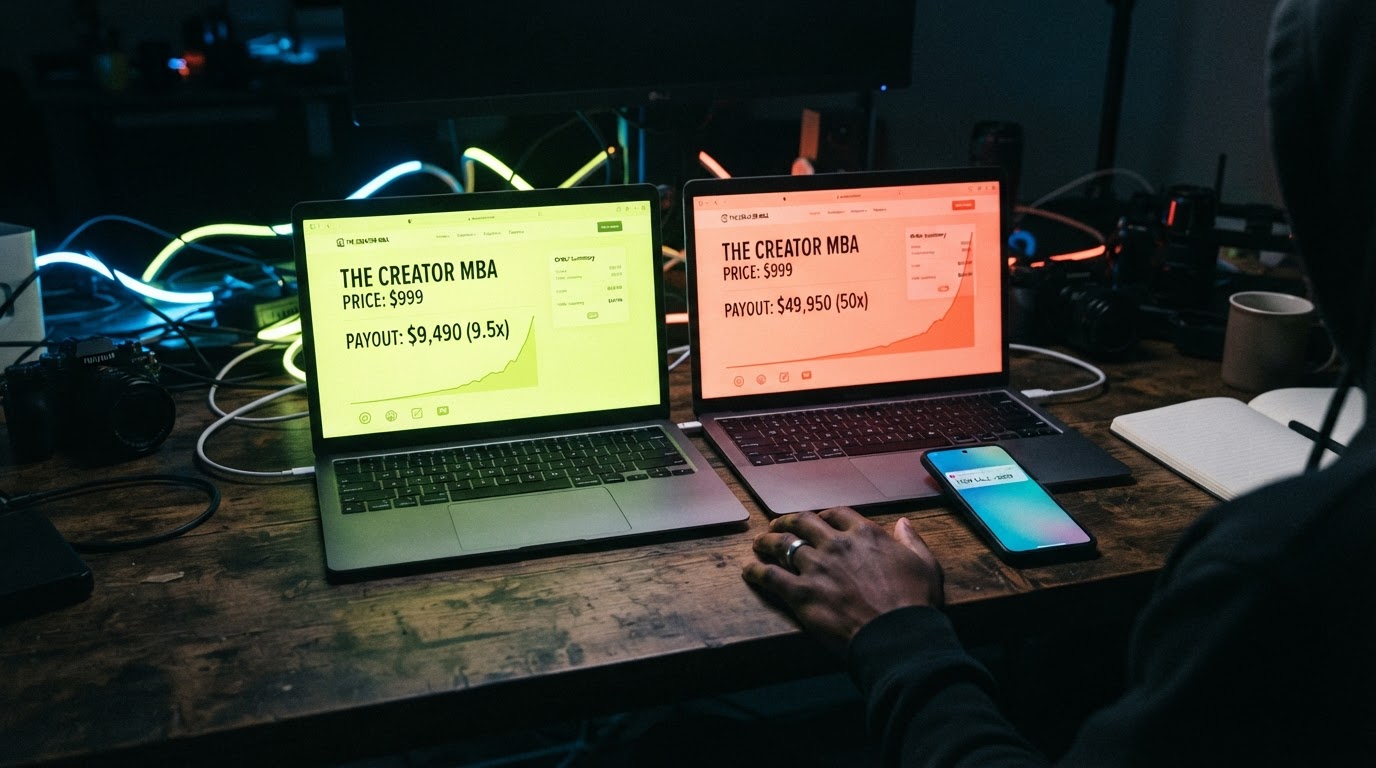
Same Course, Same Price, 2.6x the Payout. It Depends Entirely on Who Sent the Buyer.
Udemy pays instructors 97% when the student arrives through their link and 37% when the marketplace sends one. That gap is the whole business.
"Business Coaching" Is Now a Flagged Category. Your Payment Processor Just Got the Memo.
An FTC order against processor Nuvei defines coaching programs and auto-renewing subscriptions as higher-risk merchants — and spells out exactly how they get screened.