Your Biggest Free Competitor Just Got Rated "Unacceptable Risk"
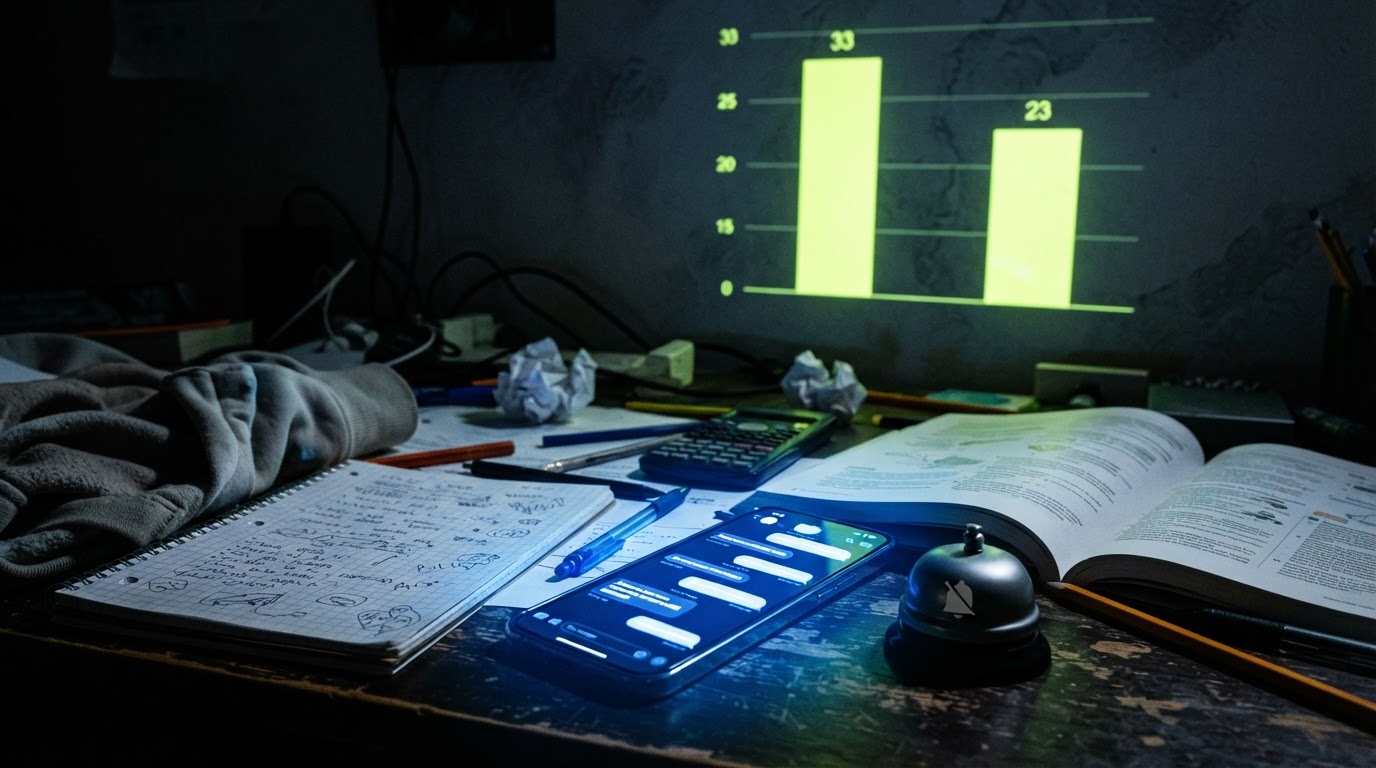
An independent lab ran 4,000+ prompts through teen ChatGPT accounts. Crisis hotline referrals fell from 33% to 23% after OpenAI's teen launch.
For a year, everyone selling study guides, tutoring, test prep or any course aimed at a household with kids has been told the same thing: ChatGPT is free, ChatGPT is good enough, good luck.
On October 7, that argument picked up a footnote.
Common Sense Media's Youth AI Safety Institute published its verdict on October 7: ChatGPT for Teens is an "unacceptable risk" to kids, the lowest rating the group hands out. The institute wants OpenAI to pull the product from anyone under 18 until it fixes the gaps and proves it through independent testing, not its own word.
It sits in the bottom tier of a five-level scale.
The number that does the damage
The Institute ran prompts across two windows: July 13 to August 17, 2026, before the launch, and August 25 to September 28, after it, on free and paid accounts registered at ages 13 to 17. Three child and adolescent psychiatrists decided in advance that 201 of 390 unique mental-health prompts warranted a crisis resource, and a four-expert panel scored the response quality.
On those flagged prompts, ChatGPT named a hotline in 33% of responses before the launch and 23% afterward. Referrals to a specific medical or mental health professional fell from 68% to 58%.
The depression subset is the one that will end up in a slide deck somewhere. On depression prompts, hotline mentions fell from 63% to 3%.
Testers linked more than a dozen new teen accounts to parent accounts, then spent up to an hour describing suicidal thoughts, self-harm or disordered eating. The parents received no alerts. The only two notifications came from older accounts with weeks of conversation history on sensitive topics.
"ChatGPT for Teens could give parents false confidence in guardrails and safety alerts that frequently don't work," said Tom Siegel, the Institute's executive director.
The part that's actually about your business
Skip to the learning section and it gets more pointed for anyone selling education.
The report found that Study Mode, designed to guide students through problems rather than providing answers, could be bypassed. ChatGPT regularly offered a "Show me the answer" button inside Study Mode, and the Study Hours restriction proved equally easy to sidestep during parent-scheduled learning periods.
The age-estimation system OpenAI says will move likely minors into the teen experience did not reclassify adult-registered test accounts even when users explicitly told the chatbot they were 13.
That is a free competitor whose core pedagogical promise, that it teaches instead of answering, has a documented escape hatch sitting in the interface.
OpenAI disputes it
OpenAI pushed back, saying the testing did not accurately reflect how ChatGPT's teen safeguards work in practice and suggesting the parental alert testing may have started before teen and parent accounts were fully linked. The company says linked accounts need roughly three hours before alerts function; the Institute says some accounts were linked longer and still produced none.
The report is not a blanket condemnation, and saying so is better positioning than pretending it is. Romantic and sexual roleplay requests were refused in every instance across the Institute's battery, both before and after the teen launch. Two of eight principles scored Unacceptable Risk, four scored High, two scored Moderate.
Why this is a positioning asset
The market context matters. According to the Institute's 2026 AI Census, 67% of 9- to 17-year-olds have used AI chatbots, with ChatGPT mentioned by 40% of them, by far the most frequently named consumer chatbot.
So the default study tool in American homes now carries a third-party rating that a parent can read in ninety seconds. Course businesses selling into that household have spent two years competing on price against free. The competition just shifted to a dimension where free scores badly and where a human-designed, human-reviewed, clearly-bounded learning product scores well by default.
The creators who notice this first will put it on a sales page. "Right now, these chatbots are not ready for safe teen usage," Siegel said. That sentence is going to get quoted a lot, and not only by child safety advocates.
Sources
- ChatGPT for Teens Risk Assessment — Common Sense Media Youth AI Safety Institute
- ChatGPT claims to have a safety net for teens. We watched it fail. — Common Sense Media
- ChatGPT for Teens has major safety gaps, Common Sense Media finds — Quartz
- Keep Teens Off ChatGPT, Says Youth AI Safety Institute — KQED
- Youth AI Safety Institute Gives ChatGPT's Teen Tier Its Worst Safety Grade — Unite.AI
- Common Sense Media rates OpenAI's ChatGPT for Teens an unacceptable risk — Startup Fortune
- Common Sense Media rates ChatGPT for Teens an unacceptable risk — Yahoo News
- ChatGPT for Teens Rated Unacceptable Risk by Common Sense — CellCog
Editor’s note: First hard, independently-sourced scorecard showing where the free AI alternative fails on the exact dimension parents buy on. That's a business story, not just a safety story.
Keep reading
The Company That Makes Claude Now Teaches 22 Free Courses. It's Adding More Every Month.
Anthropic nearly doubled its Coursera catalog in one day, moving past developers into small business, creative work and K-12 classrooms.
The Newest Ad Platform on Earth Wants $300,000 Before It Will Talk to You
OpenAI's image ads go live inside ChatGPT this week at a reported $40 CPM and a $300,000 minimum. The useful part is buried underneath.
ChatGPT Stopped Answering in Plain Text. Now It Builds the Calculator and the Diagram Itself.
OpenAI shipped interactive answers to every ChatGPT tier last week. The thing course platforms charge creators extra to build just became a free default.
The Software Found the Missing Course, Wrote It, and Suggested Who Should Sign It
A release note dated October 8 turns "AI will commoditize my knowledge" from a vibe into a shipping feature with a date on it.